What a Handful of Garden Soil Can Tell You
A handful of garden soil reveals clues about texture, structure, drainage, and root space, helping you describe the ground before choosing what to grow.
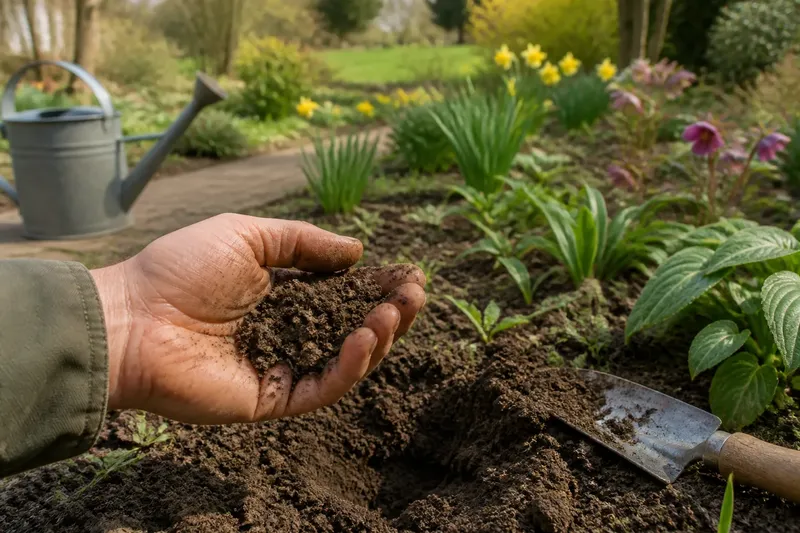
You kneel beside a bed, squeeze a damp handful of garden soil, and find either a crumbly mass, a sticky ribbon, or something that slips through your fingers. That small observation is useful: soil texture and structure influence how water moves, how roots find air, and how easily a bed can be worked. They do not name the perfect plant for you, but they give you a sensible starting description.
The distinction matters. Texture is the proportion of sand, silt, and clay in the mineral soil. Structure is how those particles gather into crumbs, clumps, or dense layers. A clay-rich soil can have a loose, crumbly structure; a sandy soil can be compacted. The handful is not a laboratory result. It is a way to notice what the ground does before you decide what to grow or change.
Read the feel
Use soil that is slightly moist, not soaked or bone dry. Take it from the rooting area rather than the surface mulch, and remove stones and bits of plant material. Rub a pinch between your fingers, then try to form a ball. Notice whether it feels gritty, silky, or smooth and sticky.
- Mostly gritty: The sample feels like fine grains and does not hold a ball for long. Sand is likely a strong part of its texture.
- Silky or floury: The sample feels smooth, with little obvious grit. Silt may be prominent.
- Smooth and sticky: The sample holds together and may smear across your palm. Clay is likely contributing strongly.
- A mix of sensations: Grit and smoothness appear together, or the sample forms a weak ball without a sticky smear. The texture may be more balanced, though a hand test cannot assign a precise soil type.
For a further clue, press a small ball between thumb and forefinger into a thin ribbon. A sample that breaks apart quickly has limited cohesion; one that forms a longer, smooth ribbon has more. Treat the result as a description, not a verdict. Organic matter, moisture, and the way the soil was handled can change what you feel.
Write down the words you actually observe: “gritty, falls apart” is more useful than “bad soil.” Keep the description plain enough that you can compare it with another part of the garden.
Notice the structure
Texture describes the particles; structure describes their arrangement. Gently break apart a small clod from the rooting zone. If it separates into small, irregular crumbs, roots and water may have connected pathways through it. If it breaks into hard plates or a dense block, movement through that layer may be more restricted. If it falls to loose grains, it may have little cohesion.
Look at the ground around the sample, too. A crusted surface, standing water after ordinary rain, or a narrow compacted strip where people repeatedly walk can tell a different story from the handful alone. Check whether roots from existing plants enter the soil or turn sideways along a hard layer. Do not dig up a prized plant just to inspect its roots; weeds or an already-open patch can offer a less destructive view.
Structure can vary sharply within one bed. The path edge may be compressed, while the center is loose; a newly filled patch may differ from the older ground beside it. Take separate notes for places that behave differently rather than averaging them into a single description.
Sort by situation
A decision guide is most useful when it starts with what you observe. Choose the description that best fits the bed, then let it shape your next question.
- Gritty and quick to crumble: Treat the soil as likely sandy or sand-rich. Water may pass through readily, and nutrients may be less consistently held. Consider plants suited to drier, freely draining ground, or plan to build organic matter gradually if you want crops that need steadier moisture. Check the label or growing instructions for the particular plant before deciding.
- Silky, smooth, and moderately cohesive: Treat the soil as possibly silt-rich. It may feel easy to shape when moist, yet a bare surface can compact or crust. Keep foot traffic off the bed and avoid working it when wet. A mix of plants with varied rooting habits can help you observe how the bed behaves across the growing season.
- Sticky, ribbon-forming, and slow to break apart: Treat the soil as likely clay-rich. It may retain water, but a dense or wet structure can make air and root movement difficult. Favor plants that tolerate heavier ground, and work from paths or boards rather than kneeling across the bed when it is soft.
- Mixed feel, crumbly clods, and roots entering freely: Treat the soil as having a workable balance for many garden choices. That does not mean every plant will suit it. Use the plant’s preferences and the bed’s light and moisture to narrow the options.
- Any texture with a hard layer or persistent surface water: Treat the site as a structure or drainage question first, not simply a plant-selection problem. Note where water collects and whether the same spot is compacted; choose plants for those conditions while avoiding an attempt to “fix” the whole bed based on one handful.
Imagine a grower finds one patch that feels gritty and another that forms a sticky ribbon. They record both separately, then choose a plant for each patch according to its stated preference for drainage and soil. The useful result is not a universal planting recipe; it is a more accurate match between a plant’s needs and the ground where it will grow.
Describe the bed
A compact field note can combine four observations without pretending to be a formal soil classification:
- Feel: gritty, silky, sticky, or mixed.
- Clod: crumbs, loose grains, a firm lump, or a plate-like break.
- Water: surface water disappears readily, remains visible, or varies by spot after rain.
- Roots and access: roots enter easily or meet resistance; note any regularly walked or worked strip.
For example, “silky, crusted surface, firm below, roots visible at the edge” is a better basis for a planting decision than “heavy soil.” It also helps you notice whether a change in one part of the bed affects the rest. You can repeat the observations in another season, using a similarly moist sample, and compare the words rather than relying on memory.
Keep surface additions separate from the soil description. Compost and mulch can improve the conditions near the surface, but a handful of mulch is not evidence about the mineral texture below it. Likewise, a bag labeled for a particular use is not a substitute for checking the existing bed. If a decision depends on a product label, manufacturer instructions, or local rules, follow those directions once the relevant condition is clear.
Questions about soil feel?
Can a hand test identify my exact soil type?
No. It can suggest whether sand, silt, or clay is prominent, but moisture, organic matter, and handling affect the feel. Use it to describe the ground; seek a formal soil analysis if a precise classification is needed for a consequential decision.
Should I test dry or wet soil?
Use slightly moist soil, since a dry sample may crumble and a saturated one may smear in ways that obscure its usual behavior. If the bed is soaked, wait until it is workable rather than squeezing a muddy sample.
Why does one bed have different textures?
Fill, past digging, foot traffic, roots, and natural layers can make nearby patches behave differently. Sample the distinct areas separately and describe each one instead of giving the whole bed a single label.
Does crumbly soil mean it is ready for any crop?
No. Crumbly structure is a helpful observation, not a complete planting assessment. Light, moisture, season, and the plant’s own growing requirements still determine whether a particular choice fits.
Choose with evidence
Before choosing what to grow, turn the handful into a short description: texture, structure, and any visible water or root clues. Then compare that description with the plant’s stated soil preferences. If the bed varies, match plants to its distinct patches rather than forcing every corner to behave alike.
What a handful of garden soil can tell you is modest but practical: where to look more closely, which conditions a plant may tolerate, and what not to assume. The best next move is often another observation from the neighboring patch, where the ground may have a different answer.