Rain Barrels Before Garden Taps Served Household Needs
Rain barrel history is easier to understand through household routines: see how roof runoff was collected, carried, and put to work before garden taps.
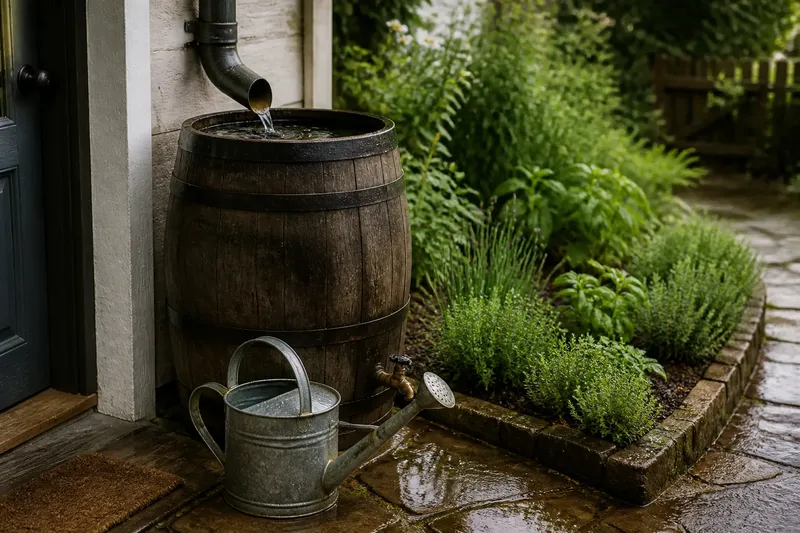
Rain barrel history begins with a practical scene: a household places a wooden cask beneath a roof edge and carries its collected water to a nearby task. Before a garden tap was common in a home, a rain barrel could make runoff available without a trip to a well, pump, or other water source.
Roof runoff at home
A roof gathers rain and directs it toward the eaves. Where a gutter and downspout carried that flow, a household could set a vessel below it and collect water rather than let it drain away immediately. The basic arrangement required no specialized garden equipment: a suitable container, a place beneath the outlet, and a way to draw water back out.
There was no single standard barrel. A household might use a cask or tub already on hand, while other arrangements depended on the building and the vessels available. Without a dated place or a particular household record, broad claims about exactly which containers people used, or how common they were, are hard to make responsibly. The useful point is narrower: collected rain was a stored supply, not water on demand.
Placement determined the work. A vessel near a door was easier to reach; one near a planting bed reduced the distance a watering can had to travel. A full container was useful only if someone could draw from it and carry the water where it was needed.
Shared household supply
Where water had to be carried, a barrel could serve more than the garden. A person might draw a modest amount for plants or another task that did not require a continuous flow. The contents were finite, so household needs competed for them; the barrel was not necessarily set aside for gardening.
A watering can or bucket made that limit visible. Each trip carried a portion of the stored supply, and the remaining water could be seen. That practical constraint shaped the work more directly than any abstract preference for rainwater.
Imagine a household with a cask beneath a downspout and a small bed of herbs beside the door. After rain, someone fills a watering can from the cask and carries it to the bed; the observable result is that the herbs receive water, while the cask’s level drops and the remaining supply is still available for another small task. If the bed were farther away, the carrying would be less convenient, and a different water source or container location might make more sense.
When taps changed access
Household plumbing did not arrive everywhere at once, and access to a tap depended on place, building, and infrastructure. It is more accurate to describe a gradual change in convenience than a single moment when barrels stopped mattering. Where a household tap was available, drawing water could take less carrying than fetching it from a storage vessel.
That changed the barrel’s possible role, not its basic function. A tap provided access when opened; a barrel held rain collected earlier. A gardener could use either, depending on the task, the barrel’s contents, and the effort of carrying water across the yard. A hose could reach a distant bed, while a can remained manageable for a nearby patch.
Rain storage therefore makes most sense as part of a particular household routine, not as a universal stage in the history of gardening. The shift from carried water to tap access varied, and a barrel could remain useful alongside plumbing.
Choosing a role today
A modern rain barrel can serve a small, nearby planting without pretending to supply every watering need. Before setting one up, consider these observations and decisions:
- Check whether a downspout directs roof runoff to the proposed spot; if it does, place the barrel there, but if it does not, choose a different outlet or use another water source.
- Check whether a watering can can reach the beds comfortably; if it can, reserve the barrel for those beds, but if it cannot, consider a closer container location or a more suitable watering method.
- Check whether the barrel has a secure cover; if it does, follow its directions for use, but if it does not, obtain a suitable cover or choose a covered storage option.
- Check whether the roof and gutter materials are appropriate for the intended use; if their suitability is unclear, consult local guidance or the product maker, but if they are unsuitable, use another source for that purpose.
- Check whether the garden’s intended use is compatible with collected roof water; if it is, use the water accordingly, but if food-crop or other use raises concerns, seek local guidance and choose a safer source when needed.
- Check whether the barrel is easy to reach during routine garden care; if it is, keep it in that location, but if it is routinely awkward, reposition it where runoff and access both work.
Collected water can pick up material from roofing and gutters. Follow the container maker’s directions and relevant local guidance, especially before using it for purposes beyond ordinary garden watering. A barrel’s presence alone does not establish that its water is suitable for every use.
Questions about rain barrels?
Why were rain barrels useful before taps?
They kept roof runoff available near a household task, reducing the need to fetch every small amount from elsewhere. Their usefulness depended on the water collected, the vessel’s position, and the work involved in carrying it.
Did household plumbing make barrels obsolete?
No single answer fits every place or household. A tap changed access where plumbing was available, while a barrel could still hold rain for nearby garden use.
Why use a watering can with a barrel?
A can carries water to a specific bed and makes the amount drawn from storage apparent. It is practical for nearby planting, but less convenient when the garden is spread out.
Is collected roof water suitable for edible plants?
That depends on the roof, gutters, storage, intended use, and applicable local guidance. Check those factors with a qualified local source or the product maker before deciding.
Make placement practical
Rain barrel history is most useful when it brings the question back to the actual household: where does collected water fit into the work? Put storage where runoff reaches it and where a watering can can be carried without undue effort. A barrel that is easy to use for a clearly chosen task is more practical than one placed for appearance and left to collect dust, along with the rain.