Upright, Mounded or Spreading: Which Plant Shape Fits a Border?
Plant shape for borders helps you judge height, width and direction before planting, so each plant has room and the border reads as a considered whole.
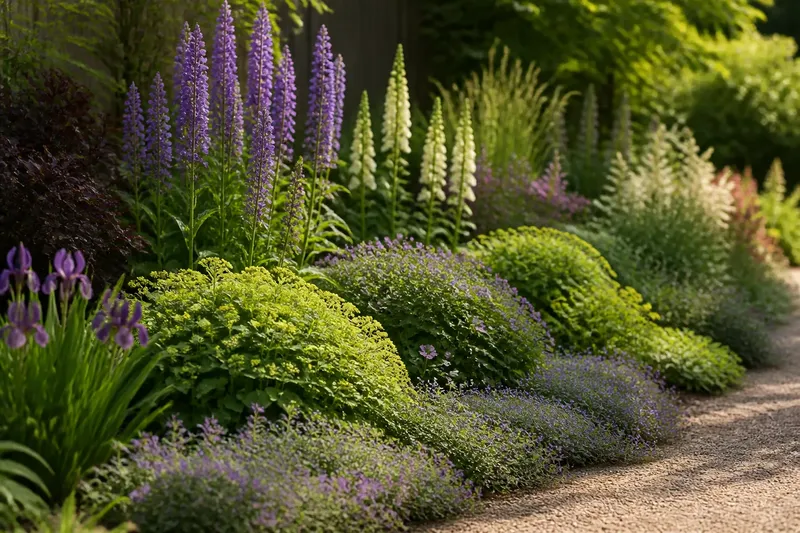
A nursery pot can look modest on a bench and surprisingly ambitious in a border. Plant shape for borders is a useful way to judge that ambition: upright plants climb visually, mounded plants gather into rounded forms, and spreading plants travel outward. Those habits affect not only spacing but also how a planting reads from the path, the window and the seat at its far end.
These are broad descriptions, not strict botanical categories. A plant may be upright in flower and mounded in leaf, or spread slowly until neighboring stems give it nowhere to go. Read the plant label for its mature height and spread, then look at the plant itself: the direction of its stems often tells you what a number alone cannot.
Read the growth habit
Upright: Stems rise more than they extend sideways. The result may be a narrow column, a loose fountain or a cluster of vertical flower stalks. Upright forms provide height without taking as much lateral room as a broad mound, though a narrow plant can still cast shade or lean into its neighbors.
Mounded: Growth arcs outward and upward, making a rounded or domed shape. Many foliage plants and compact perennials fall into this group. A mound can soften a hard edge and fill the middle of a border, but its widest point may sit near the ground rather than at the top.
Spreading: Stems, runners or low branches extend sideways, sometimes rooting where they touch soil. Spreading plants can cover open ground and soften the front of a bed. Their reach may be gradual or assertive; the label’s width and a look at the plant’s growth method help distinguish the two.
Think of the categories as a sketching shorthand. They are useful before planting, but actual plants respond to light, soil, pruning and competition. A sunny site can make one plant compact and dense; shade may draw the same stems toward the light.
Use height as a view
Height is not only a question of where the tallest plant goes. It determines which leaves and flowers remain visible, which plants partly screen one another, and whether the border has a clear outline from the main viewing point.
Upright forms make visible accents. A cluster of flower spikes or narrow stems can punctuate a run of lower foliage without creating a continuous wall. Several tall plants placed at intervals usually give the eye places to pause; a solid row can read more like a hedge, which may be useful when that is the intention.
Mounded plants make a lower, fuller profile. Put them where their rounded outline can be seen against a contrasting background: a dark fence, a taller plant, or open space. If a mound is placed directly behind another plant of similar height and color, the two can merge into a single lump. Plants do not object, but the gardener may.
Spreading plants are often low, though low does not mean invisible. A broad mat can draw the eye along the border and make a clean transition to a path. Where a spreader grows over a path edge, decide whether that softness is welcome or whether the edge needs regular trimming.
Stand where you usually look at the border before deciding on the back, middle and front. A planting viewed from one side can use height in layers; a bed seen from all sides needs tall forms placed so they do not hide everything behind them.
Space the mature outline
Spacing by the size of the pot is a reliable way to create a crowded border. Instead, picture the plant at its expected mature width. For a roughly rounded plant, that width describes a circle around its center. Upright forms may need less room to either side, while spreading forms may need room well beyond the nursery pot’s footprint.
The mature spread on a label is a planning estimate, not a promise about the exact shape. Check whether the plant is described as clumping, creeping, running or self-seeding. A clump generally expands from its base; a creeping stem may extend well beyond it. Those differences matter when the plant is near a path, a small shrub or a neighbor that dislikes being crowded.
Say you have a narrow border beside a walkway and are considering one upright perennial, one rounded foliage plant and a low spreader. Mark the expected widths on the soil with short sticks or a loose loop of garden twine. If the spreader’s outline crosses the path and the upright plant’s stems would lean over the mound, shift the centers before digging; the visible result should be a clear path edge and distinct shapes rather than a tangle at ankle height.
When exact spacing is unclear, leave a little breathing room rather than planting tightly to fill every gap. Temporary bare soil is easier to address than a mature plant that must be moved through its neighbors. Mulch can make an open patch look deliberate while the planting develops.
Layer the three forms
A border often feels coherent when its outlines vary but its plants have room to show them. One simple arrangement is an upright accent behind or among mounds, with a spreader at the front. The forms then occupy different visual zones: vertical emphasis, rounded body and low edge.
This arrangement is not a rule to apply blindly. A tall upright plant can shade a small mound, and a vigorous spreader can swallow the front of the bed. Check each plant’s light needs and expected reach. If the plants require different conditions, put them in separate patches rather than forcing a tidy composition that is inconvenient to maintain.
Repetition helps the eye understand a border. Repeat a shape or plant at intervals, then use a contrasting form between those repeats. For instance, a few mounded plants can establish a rhythm, while an upright accent breaks it and a low spreader links the gaps. Repetition need not mean a ruler-straight row; staggered placements can preserve a natural outline.
Keep some open ground visible between unrelated forms, especially where leaves would otherwise overlap heavily. Air and light reaching foliage can make the planting easier to inspect and maintain. Leave enough access to reach the base of a plant for ordinary weeding and deadheading without stepping into the bed.
When does each shape fit?
Which shape works in a narrow border?
Upright plants often use less sideways room, while a compact mound can fill a small gap without extending far. Check mature width and the direction of the stems; a narrow label does not rule out leaning growth.
Where should a spreading plant go?
Place it where its sideways growth has a useful destination, such as an open front edge or a patch of bare ground. Keep it away from plants you need to preserve as distinct clumps unless you are prepared to trim or divide it.
Can all three shapes share one border?
Yes, if their light, soil and moisture needs are compatible and their mature sizes leave room for one another. Use height and spread to arrange their outlines, then check that the tallest foliage will not shade plants that need more sun.
How do I judge a plant with changing shape?
Look at both its foliage and flowering stems, and read its description for seasonal changes. If the shape is still unclear, give the plant space and observe its growth before placing a close neighbor beside it.
Adjust the sketch in place
Set nursery pots on the soil before planting, with each pot centered where you think the plant belongs. View the arrangement from the path and from any window or sitting area that matters. This gives a quick sense of height and rhythm, though a small pot represents a much smaller footprint than the mature plant.
Use a few sticks, plant labels or lengths of twine to mark the estimated mature outlines. Move the markers until the shapes overlap only where you intend them to. The method is especially useful for a border with a tight path edge or a mixture of upright and spreading plants.
After planting, keep the intended outline in mind during routine trimming. A spreading plant can be cut back at the edge if it begins to cover a path; an upright plant may need its spent stems removed when its display is over. A mound generally needs room to keep its rounded outline rather than frequent shearing into a ball.
Pruning changes a plant’s form, so avoid cutting simply to force every plant into the same silhouette. Follow the plant’s label or the grower’s instructions for timing and method; requirements vary among plants. For routine border planning, mature height, mature spread and the direction of growth are enough to make a sound first sketch.
Let the shapes settle
A new border rarely looks finished at once. A space between plants may be part of the plan, not a defect, and some forms take time to fill out. Resist the urge to add another plant wherever soil is visible; first check whether the existing spreaders and mounds are still developing.
When choosing plant shape for borders, start with the view you want to keep open, then fit each plant’s mature outline into the available ground. Upright stems can add height, mounds can give a planting body, and spreaders can connect the front edge. Leave enough room to see where one form ends and the next begins; that small decision makes later weeding and editing less of a negotiation.