A Late-Autumn Walk Around the Garden
A late-autumn garden walk helps you decide which seed heads, leaves, and stems can stay through winter, and which need clearing for a sound reason.
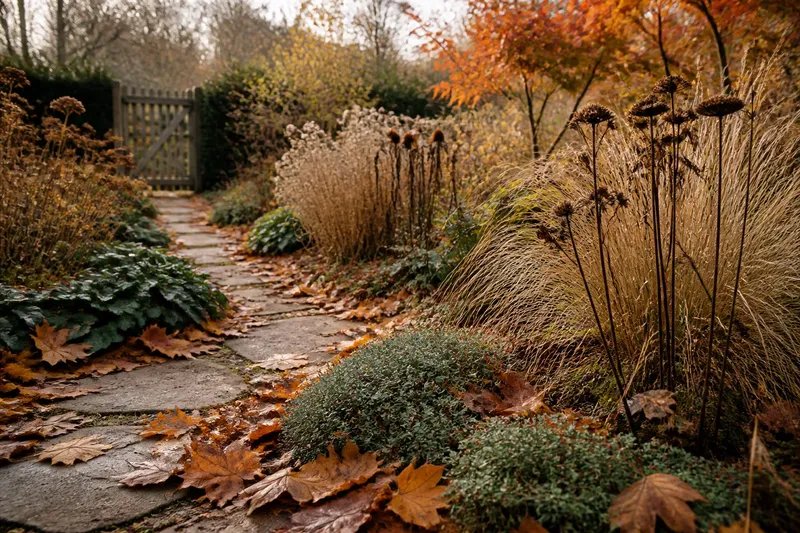
A late-autumn garden walk often begins with a leaf stuck to the path and ends with a full wheelbarrow you did not plan to fill. Before reaching for the rake, take a slower circuit. A late-autumn garden walk is a way to decide what is worth leaving in place through winter, based on what each plant is doing and what the space needs.
The aim is not to make the garden look untouched, or to tidy nothing on principle. It is to notice structure: seed heads, stems, leaf cover, and the gaps between them. Then you can distinguish useful winter presence from material that blocks a path, covers a small plant, or has a clear reason to come out.
Start with the route
Choose a circuit that takes in the main beds, lawn edges, containers, and paths. Walk it once without tools. A pencil and a scrap of paper are enough if you want to record decisions, but a phone photo can also help you compare the garden’s structure with what you remember from summer.
At each stop, pause before judging a plant by its untidy outline. Ask three simple questions: What is still standing? What is lying down? What is it touching or covering? That last question matters. A loose layer of leaves on open soil is different from damp foliage packed against the crown of a small perennial.
Make a short mental list of places that need attention rather than moving continuously from one task to another. This keeps the walk an observation round, not an invitation to start pruning every shrub in sight.
Read the seed heads
Seed heads give a border its winter outline. Their shapes can remain legible after petals and leaves have gone: a flat disk, a branching spray, or a narrow cone may stand out against bare soil. Some also hold seed that birds may use, though whether it remains available depends on the plant and the weather.
Notice whether a stem is firm enough to stand through wind and wet conditions. A sturdy upright stem may keep its shape, while a heavy head on a thin stem may already be leaning across a path. Leaving the first can preserve structure; cutting back the second may be a practical choice if it repeatedly obstructs access.
Check for seed heads that are already shedding freely. If you do not want a plant spreading into nearby gaps, removing its heads before they scatter may suit the garden better. If a seedling elsewhere would be welcome, leaving some heads is a reasonable gamble, not a promise that new plants will appear where you want them.
For any unfamiliar plant, use its label or the grower’s guidance to understand whether it is likely to spread or needs a particular seasonal treatment. That information can change a sound-looking stem from a keeper into a plant you would rather manage.
Follow the fallen leaves
Leaves are not a single material with one correct destination. Their effect depends on where they land. A thin, loose layer over an open bed can soften the bare look of soil, while a thick, wet mat over low plants can hold them down and keep air from reaching their foliage.
Look at the edges of evergreen ground cover, small rosettes, and newly planted perennials. If leaves have collected there, lift a handful gently and see what lies beneath. Where foliage is still visible and firm, a light covering may be harmless. Where a mat has flattened a plant or formed a dense, soggy patch, move the leaves to a more suitable spot.
Paths and steps deserve a separate check. Wet leaves can become slippery, and leaves packed into a narrow path are not serving as a helpful garden layer. Clear walking surfaces, then decide whether the material is sound enough to use elsewhere or should go into the appropriate garden-waste stream.
Say you find a broad drift of maple leaves covering a low patch of thyme beside a stepping-stone path. You could rake the leaves off the stones, lift the dense mat from the thyme, and spread a thin layer across an open bed. The observable result to look for is a clear walking surface, visible thyme foliage, and leaves resting loosely rather than pressed into a pile.
Keep the stems that hold
Plant structure is easiest to assess by looking at the whole bed, not one stem at a time. A clump of upright grasses, the branching stems of a perennial, or the framework of a deciduous shrub can give a border shape when neighboring plants have died back. A few irregular stems may look less disorderly in a group than they do under close inspection.
Follow the stem down to its base. Check whether it is firm, whether it is leaning into a path, and whether it is tangled with another plant. A stem that bends but remains attached may still be worth leaving; a broken stem lying across a young plant may be better moved. The useful question is not whether a plant looks pristine, but whether its remaining form has a place in the bed.
Look for the garden’s visual balance as well. One upright clump can feel isolated in a large empty bed, while several seed-bearing plants along a border can make a coherent line. The same plant may be worth keeping in one position and cutting back in another because the path, planting density, or view differs.
What should stay until spring?
Should all seed heads remain?
No. Leave firm, well-positioned heads if you want winter structure or are willing to let some seed fall. Remove heads that are spreading where you do not want seedlings, or that have collapsed into a path.
Can fallen leaves stay on garden beds?
Often, if they form a loose layer over open ground and are not smothering plants. Move dense, wet accumulations away from low foliage, crowns, and walking surfaces.
When should perennial stems be cut back?
There is no single date that suits every plant and garden. If a stem remains upright and is not causing a problem, leaving it for now is a reasonable option; cut it back when it becomes obstructive or its condition calls for removal.
What if a plant’s winter needs are unclear?
Identify it before making a major cut, then check its label or reliable growing guidance. If it is still unknown, mark it for later rather than guessing at a treatment that may be hard to reverse.
Make a short decision list
As the circuit continues, sort observations into three choices: leave, move, or remove. These are practical categories, not judgments about good or bad gardening. A leaf pile can be welcome in one bed and inconvenient on a path; a seed head can be valuable for its shape but poorly placed beside a gate.
- Leave: Firm stems and seed heads that stand clear of paths and suit the bed’s winter outline.
- Leave lightly: Loose leaves on open soil where they do not cover low plants or block access.
- Move: Dense leaf piles resting on small plants, or leaves gathered on steps and narrow paths.
- Remove: Broken or fallen stems that press on neighboring plants or repeatedly obstruct movement.
- Mark for later: Unidentified plants or uncertain stems whose treatment depends on knowing what they are.
If you keep notes, make them specific enough to use. “Clear leaves” is vague; “lift leaves from the path and low thyme” is a decision you can carry out without reconsidering the whole bed. A small note can also prevent a tempting but unnecessary cut when you return with pruning shears.
Finish with one pass
Before ending the walk, look back from the places where you normally see the garden: a kitchen window, the back door, or a favorite seat. The garden will present a different shape from each angle. A retained clump may frame a view from the house but lean across the route to the shed. Keep the useful structure and resolve the obstruction rather than making the whole bed uniformly bare.
Then do only the clear work you identified: lift a leaf mat, clear a slippery step, or move a fallen stem. Leave the rest for another day if the conditions are poor or the plant’s identity is uncertain. The point of a late-autumn garden walk is to make winter decisions with your eyes open, not to finish every seasonal task in one trip.
When the circuit is done, leave a few deliberate signs of life in view: a seed head above a quiet bed, loose leaves on open ground, or a sturdy stem holding its line. A useful late-autumn garden walk does not end with everything cleared; it ends with knowing why the things left behind belong there.